


Blog
11.19.26
Two HTTP/2 Flaws in nginx, and Two Very Different Risks

Thomas Nuth
Vice President of Product Marketing

Two advisories, both fixed in nginx 1.31.9 mainline and 1.30.7 stable, both released 18 November 2026.
CVE-2026-123007, which nginx titles "Memory corruption in HTTP/2 flow control" and rates major. Affected versions run from 1.9.5 to 1.31.8, which is a decade of releases. The changelog entry reads: "a flow control window overflow in HTTP/2 might allow an attacker to cause a segmentation fault in a worker process, or might have potential other impact." Credit goes to Xint.io.
CVE-2026-123633, which nginx titles "Use-after-free in HTTP/2" and rates medium. Affected versions run from 1.19.7 to 1.31.8. The changelog entry reads: "use-after-free might occur in a worker process when using HTTP/2 if worker_connections were not enough." Credit goes to Albert of Vexera AI.
NGINX Plus builds are affected too, and F5 has published advisories for each.
Treating these as one event is the first mistake available, and the naming encourages it.
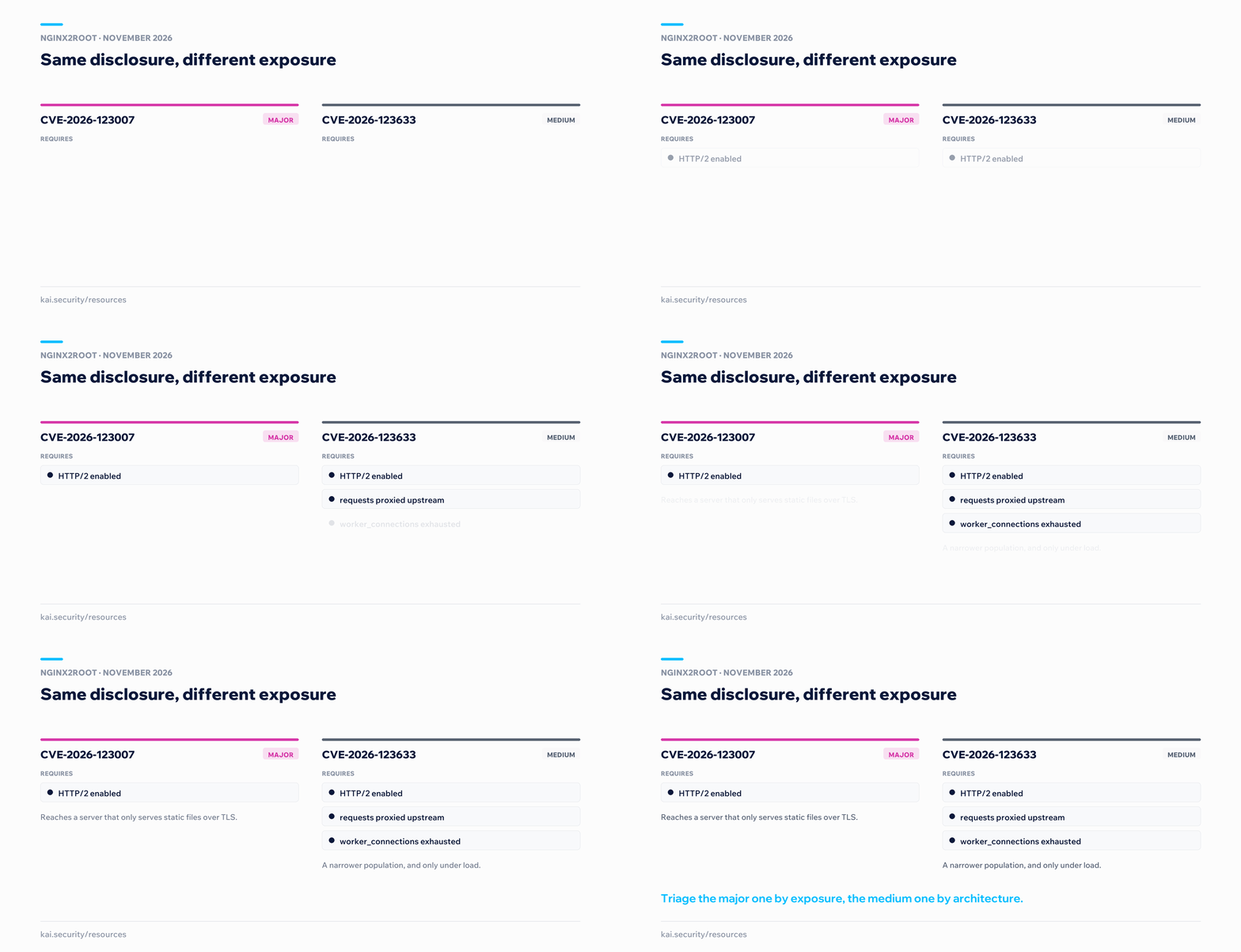
CVE-2026-123007 needs HTTP/2 enabled. That is the whole precondition. It reaches a server that does nothing but serve static files over TLS, with no backend, no third party module and no unusual directive. If you terminate HTTP/2 anywhere on the internet, you are in scope.
CVE-2026-123633 needs more. It needs HTTP/2, it needs requests forwarded to an upstream, and it triggers when nginx runs low on free connections, which is what worker_connections were not enough means in the changelog. That is a narrower population and a less convenient bug to drive, which is why nginx rates it medium.
If you are triaging by hand, that distinction decides your order of work. Every internet facing nginx with HTTP/2 on is exposed to the major one. Only your proxies are exposed to the medium one, and only under load.
This one is worth slowing down for, because it affects how you brief your own leadership.
nginx does not use the words remote code execution for either flaw. It says segmentation fault in a worker process, and it says potential other impact. That is not vendor coyness about a known fact: the same changelog says "potentially resulting in arbitrary code execution" about a different nginx CVE earlier this year, so the project is willing to use the phrase when it means it.
The researchers say something stronger. Xint published under the banner "From nginx visitor to root of the server host". CIRCL's TR-105, dated 18 November and marked TLP:CLEAR, describes the set as five vulnerabilities "that can allow an unauthenticated remote attacker to execute commands with the privileges of an NGINX worker", and reports demonstrated unauthenticated RCE in a research setting. Wiz is reported to have confirmed code execution with an ASLR bypass against official 1.31.7 and 1.31.8 builds.
So the honest position is this. Code execution has been demonstrated by credible researchers under laboratory conditions, and it has not been confirmed in the vendor's own text. Both teams withheld their exploit code, and nobody has reported exploitation in the wild. Patch anyway, and patch urgently. But when you write the internal note, say which claim is doing the work, because in three weeks somebody will ask you where the RCE came from and the answer is a research demonstration rather than an F5 statement.
The mitigation everyone is sharing is http2 off; on nginx 1.25.1 and later, or removing http2 from your listen lines on older builds. It works, and it is the right emergency lever if you cannot patch today.
It also covers two of the five nginx2root CVEs. The other three are untouched by it:
CVE-2026-123634, a use-after-free in the DNS resolver, which needs resolver plus a request derived proxy_pass plus a subrequest such as mirror. Point proxy_pass at a fixed upstream group instead, and turn off mirror where it is not needed, while knowing that SSI can reach the same code path.
CVE-2026-121810, a use-after-free when a QUIC connection closes mid request, which needs HTTP/3 with upstream forwarding. Remove quic listeners, set http3 off;, send Alt-Svc clear, and block UDP on that port.
CVE-2026-113425, a use-after-free in mail proxy authentication, which needs the mail proxy with proxy on and auth_http. Bind mail listeners to loopback or restrict them at the firewall.
CIRCL says it plainly: disabling HTTP/2 is not a complete nginx2root mitigation. If your change ticket says "mitigated, HTTP/2 disabled", it is describing two fifths of the problem.

The name promises host root. The chain does not start there.
CIRCL is explicit that exploitation "initially runs with the permissions of the worker process, not automatically as root". Getting from a compromised worker to root reportedly uses a second flaw entirely, a Linux kernel SCTP use-after-free that Xint is withholding details on. That flaw has no CVE identifier and no kernel fix. Xint's demonstration is reported to have run commands as the worker inside a Docker container and then escalated to root on the underlying AWS host.
Two consequences for you. First, a compromised nginx worker is already serious, and you should plan for it on its own terms rather than treating worker access as a near miss. Second, the escalation step is cheap to break and nobody is talking about it: many distributions load the SCTP module automatically the first time something opens an SCTP socket. Dropping install sctp /bin/false into a file under /etc/modprobe.d/ stops that. It will not unload a module that is already loaded, and it does nothing if SCTP is compiled into the kernel, so verify rather than assume.
That is a control you can apply today, it is independent of nginx entirely, and it blunts the part of this disclosure that made the name.


